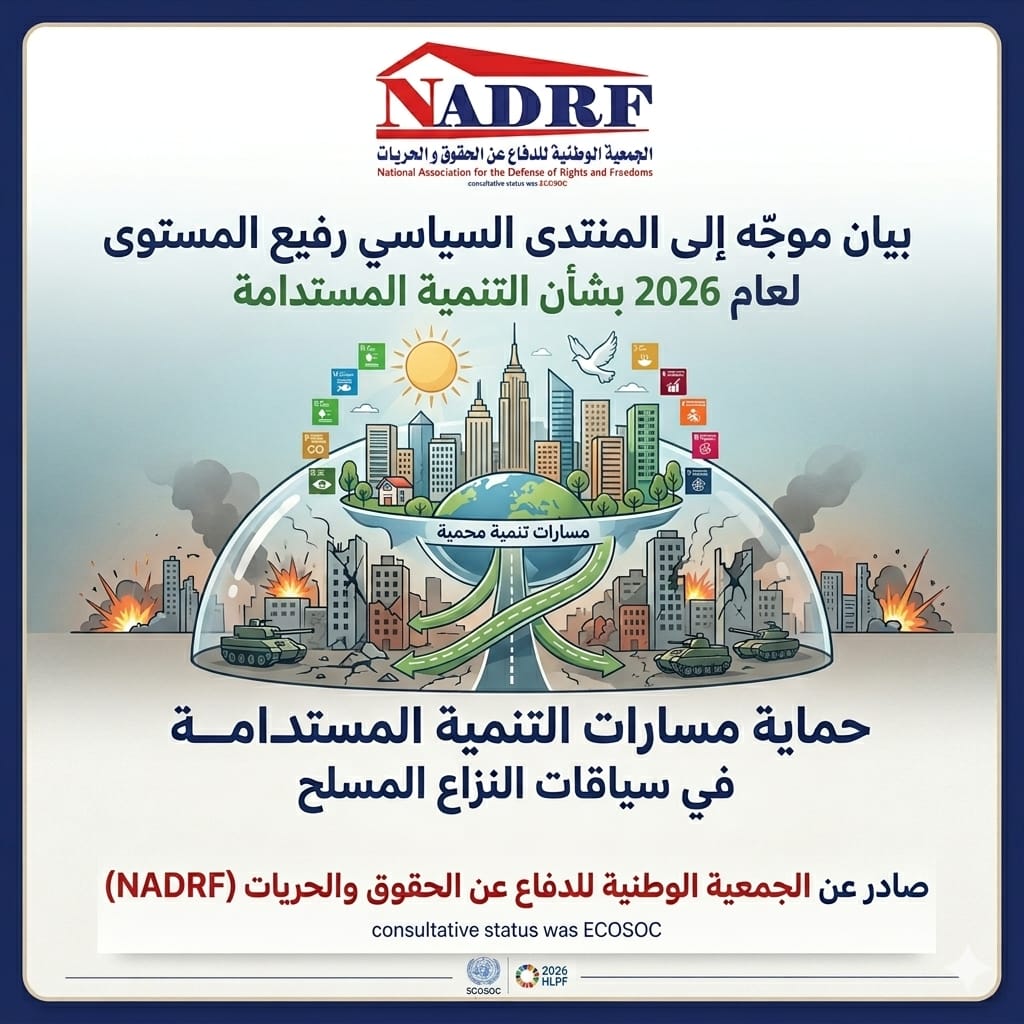
Protecting Sustainable Development Pathways in Contexts of Armed Conflict Statement to the 2026 High-Level Political Forum on Sustainable Development
-
by
 Nadrf
Nadrf - لا توجد تعليقات على Protecting Sustainable Development Pathways in Contexts of Armed Conflict Statement to the 2026 High-Level Political Forum on Sustainable Development
 Nadrf
NadrfThe National Association for the Defense of Rights and Freedoms (NADRF) submitted this official statement to the 2026 High-Level Political Forum on Sustainable Development of the United Nations Economic and Social Council (ECOSOC), based on the Association’s special consultative status with ECOSOC. The Forum is scheduled to be held from July 12 to 16, 2026. This statement is part of the Association’s efforts to strengthen the role of civil society in monitoring the implementation of the 2030 Agenda for Sustainable Development and to highlight the complex challenges facing the achievement of sustainable development. It also emphasizes the need to link development with peace and to promote human rights, particularly in the Middle East and the most fragile regions around the world.
The Association believes that the 2026 High-Level Political Forum represents a strategic opportunity to reassess the Sustainable Development Agenda, not only in terms of progress made but also in terms of the ability of current development models to address the growing challenges posed by ongoing armed conflicts. The recurring armed conflicts in the Middle East and other regions pose the greatest threat to achieving the Sustainable Development Goals. These conflicts destroy vital infrastructure, disrupt essential services, deplete economic and social resources, and increase poverty and marginalization, hindering development and limiting the ability of governments and societies to achieve stability and peace. The association points out that armed conflicts not only affect the economic and social fabric but also pose a direct threat to peace and human rights. They cause mass displacement, grave violations of fundamental rights, and restrict communities’ access to essential services such as water, energy, education, and healthcare. In this context, the association emphasizes that sustainable development is inseparable from peace and human rights, and that protecting civilians and ensuring the continuity of essential services is the cornerstone of any successful development strategy. The association stresses the need to enhance the effectiveness of the United Nations and its mechanisms to meet the scale of current challenges, including recurring conflicts. The inability of some mechanisms to respond effectively increases the risk of deteriorating humanitarian situations and impedes the implementation of the 2030 Agenda for Sustainable Development. The association believes that developing and reforming UN mechanisms to ensure their ability to anticipate and manage crises and protect civilians is a prerequisite for enabling development, achieving social justice, linking development to peace, and promoting human rights. The region
The association emphasizes that protecting sustainable development requires reformulating development policies, particularly in vital areas such as water, energy, infrastructure, and cities, within a framework that links conflict, development, peace, and human rights. This framework must consider the humanitarian, social, and economic impacts of armed conflicts. The association affirms that protecting vital infrastructure is not an option but a prerequisite for achieving sustainable development, calling for the establishment of binding international mechanisms to prevent the targeting of such infrastructure, along with strict international accountability for serious violations.
The National Association for the Defense of Rights and Freedoms (NADRF) presents a comprehensive and integrated strategic vision with a rights-based and developmental character. This vision is based on the inseparable integration of sustainable development, peacebuilding, and the promotion and protection of human rights as a single, interconnected system where none of its elements can be achieved in isolation. This vision stems from the necessity of redirecting national and international development policies towards addressing the root causes of armed conflicts, rather than merely managing their repercussions. This can be achieved by adopting a preventive rights framework that places people at the heart of the development process and links development planning with the principles of justice, the rule of law, and conflict prevention. In this context, the association emphasizes that achieving sustainable development in conflict contexts requires integrating human rights standards into all stages of policymaking. The association emphasizes the importance of comprehensive development, from planning to implementation and evaluation, with the establishment of precise mechanisms to measure the true impact of development on the lives of individuals and communities, not just on quantitative indicators. It also stresses the importance of ensuring equitable access to basic services without discrimination, promoting equal opportunities, improving quality of life, and working to reduce widening socio-economic gaps. This will solidify the principles of equality, equity, and non-discrimination as fundamental pillars of just and sustainable development.
Furthermore, the association calls for a radical shift from a reactive crisis response approach to adopting comprehensive and sustainable preventive strategies. These strategies should be based on developing effective early warning systems and risk analysis, enabling the international community to anticipate and prevent the escalation of conflicts before they occur. In this context, the association emphasizes the importance of building international partnerships based on the principles of justice, solidarity, and shared responsibility. It also stresses the need to provide sustainable technical, financial, and institutional support to countries and communities affected by conflicts, thereby enhancing their capacity for recovery and reconstruction along sustainable, rights-based development paths. The association further emphasizes the necessity of activating the role of civil society as a key player in the global governance system and an essential partner in monitoring, documentation, accountability, independent oversight, ensuring transparency, and promoting community participation. Finally, it underscores the importance of supporting the development of models Resilient development capable of withstanding repeated shocks and crises, ensuring sustainable development and strengthening the foundations of sustainable peace and the protection of fundamental rights in fragile and conflict-affected environments. In the same vein, the association emphasizes that achieving these profound structural transformations requires genuine and effective international political will and radical reforms to the global governance system to enhance