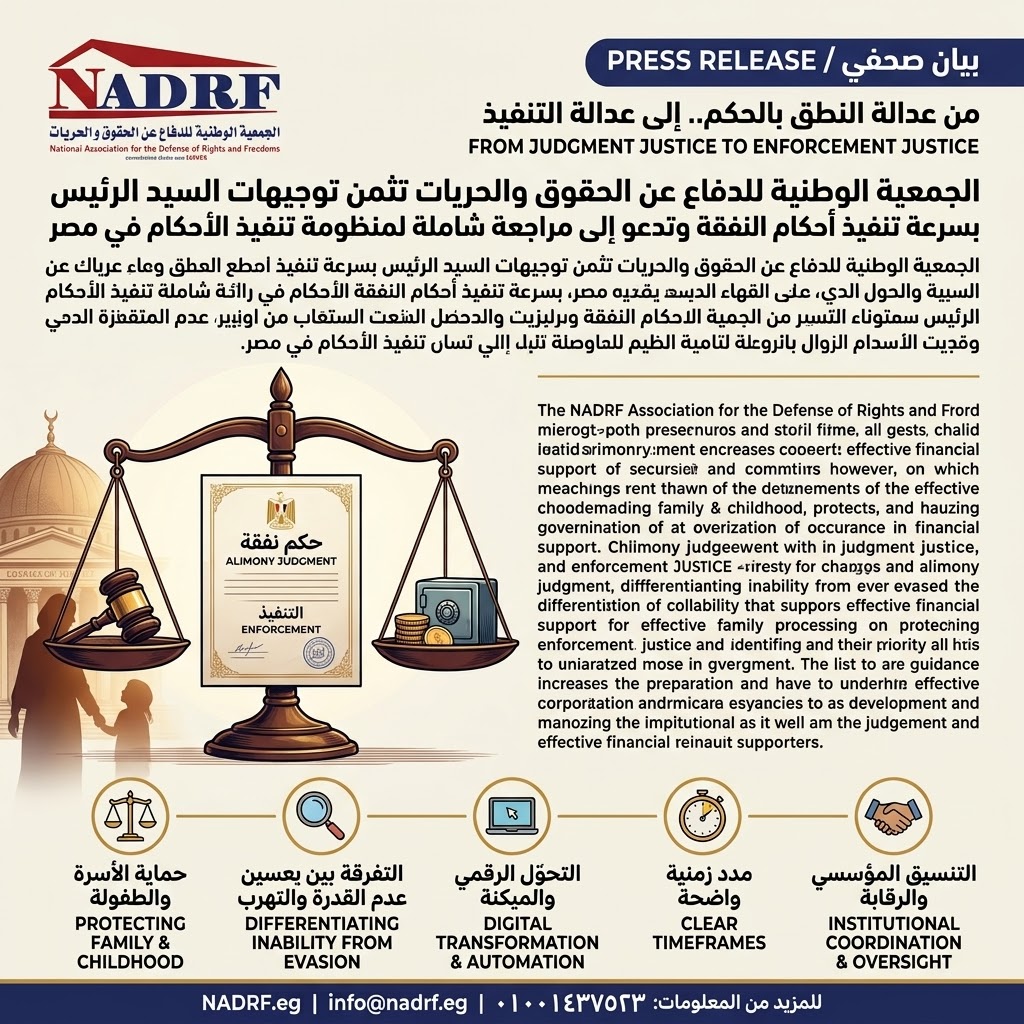
“Justice Is Not Complete Without Enforcement”: National Association Welcomes the President’s Directives on Expediting Maintenance Judgments
-
by
 Nadrf
Nadrf - لا توجد تعليقات على “Justice Is Not Complete Without Enforcement”: National Association Welcomes the President’s Directives on Expediting Maintenance Judgments
 Nadrf
NadrfNational Association for the Defense of Rights and Freedoms
Welcomes the President’s Directives to Expedite the Enforcement of Maintenance Judgments
Calls for a Comprehensive Review of the Judgment Enforcement System in Egypt
The National Association for the Defense of Rights and Freedoms welcomes the President’s directives concerning the expedited enforcement of maintenance judgments and considers them an important step toward strengthening the rule of law and upholding the right to effective access to justice. The Association emphasizes that a judicial judgment should not remain merely a legal decision but must translate into an enforceable right that reaches its rightful beneficiary within a reasonable timeframe.
The Association believes that the significance of these directives extends beyond maintenance judgments and provides an opportunity to undertake a broader review of the judicial judgment enforcement system in Egypt on the basis that enforcement is the stage at which justice is ultimately fulfilled. The right to litigation does not end with obtaining a judicial judgment but necessarily includes the right to have that judgment enforced within a reasonable period through clear effective and transparent procedures. Unjustified delays in enforcement may substantially undermine the practical value of a judgment and may allow the harm that the judgment was intended to remedy to continue.
Maintenance judgments are of particular importance because of their direct connection to the protection of the family and children and to fundamental social and economic rights. Delays in enforcing such judgments may directly affect the living conditions of children and beneficiary families and their ability to access food education healthcare housing and other basic necessities. Accordingly the prompt enforcement of such judgments constitutes an important safeguard for the rights of those who are most vulnerable.
The Association stresses that the enforcement of maintenance judgments must be addressed from a balanced human rights perspective that guarantees the right of the judgment creditor to receive their lawful entitlements while respecting at the same time the legal safeguards afforded to the judgment debtor. In this regard a clear distinction must be made between a genuine inability to fulfill the obligation and deliberate evasion of enforcement.
Where an actual inability to pay is objectively established legal mechanisms should be available to take into account the judgment debtor’s genuine financial circumstances while preserving the beneficiary’s right to receive the amounts due. By contrast where the debtor is demonstrably able to fulfill the obligation but deliberately conceals assets or sources of income makes sham transactions transfers assets for the purpose of obstructing enforcement or resorts to deceptive means to evade the obligation this constitutes a fundamentally different situation that requires the effective application of legal measures to address such practices and safeguard the authority and enforceability of judicial judgments.
The Association considers this distinction essential to the achievement of justice. Genuine inability to pay should not automatically be treated as deliberate evasion while claims of inability should not be allowed to become a means of obstructing judgments or depriving them of their practical effect. The enforcement system must therefore be capable of objectively assessing the actual financial capacity of each case and responding in accordance with the law in a manner that balances the protection of the rights holder with respect for the rights of the judgment debtor.
Against this background the Association calls for a comprehensive review of the judgment enforcement system in Egypt with the aim of identifying the causes of delays administrative obstacles and areas of institutional overlap and of simplifying procedures and eliminating unnecessary stages in order to ensure faster and more efficient enforcement of judicial judgments.
The Association also emphasizes the importance of expanding digital transformation within the enforcement system and establishing lawful and secure links between relevant databases while safeguarding privacy and personal data. It further calls for the development of electronic mechanisms that enable citizens to follow the different stages of judgment enforcement and understand the measures taken and the reasons for any delays without being required to repeatedly undertake paper-based procedures.
The Association also calls for the establishment of clear timeframes for enforcement procedures and the development of performance indicators measuring enforcement rates and the causes of delays. Such mechanisms would help identify shortcomings and address them on an ongoing basis. The Association further stresses the importance of strengthening the human and technical capacities of enforcement authorities providing continuous legal and digital training for personnel and enhancing coordination among the relevant institutions.
At the same time the Association emphasizes the need to develop more effective mechanisms for detecting attempts to circumvent enforcement while ensuring that any measures taken are based on objective evidence and data and implemented within the framework of the law and the applicable judicial safeguards.
The Association places particular emphasis on groups that are most adversely affected by delays in judgment enforcement including children women older persons persons with disabilities and others whose rights are directly connected to essential needs that cannot tolerate prolonged delays. The nature of the right established by the judgment should therefore be taken into consideration when determining enforcement priorities and the urgency with which cases should be addressed.
The Association also calls for clear and effective mechanisms for complaints and grievances relating to delays in enforcement allowing rights holders to follow the status of their judgments and understand the reasons for any unjustified delay while ensuring appropriate oversight of enforcement procedures and preventing their misuse.
In this context the National Association for the Defense of Rights and Freedoms calls for the launch of a national dialogue bringing together relevant authorities legal experts academics and civil society organizations with the aim of developing a comprehensive vision for improving the judgment enforcement system in Egypt and examining the legislative administrative and digital reforms required to ensure enforcement that is faster more effective and more equitable.
The Association stresses that moving from justice in issuing judgments to justice in enforcing judgments represents one of the most significant challenges facing the development of the justice system. The expedited enforcement of maintenance judgments can serve as an important starting point for broader reform of the enforcement system in a manner that strengthens the rule of law reinforces public confidence in justice institutions and ensures that judicial recourse ultimately produces a tangible outcome for rights holders.
The Association concludes by reaffirming that justice is not complete merely upon the issuance of a judgment but only when that judgment is effectively enforced. The rule of law should not be measured solely by the existence of legislation and judicial judgments but also by the ability of state institutions to enforce them fairly effectively and proportionately while protecting the rights of judgment creditors and safeguarding at the same time the legal guarantees afforded to judgment debtors